HERE THERE
Caroline Louise Miller, Stefani Byrd, and Alarm Will Sound Ensemble
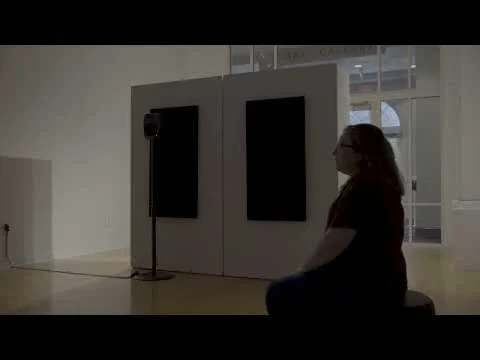
Immersive Media Installation (3-Channel 4K Video, 4.1 Surround Sound, and 2-Channel Parabolic Dome Speaker Audio)
2020 - 2024

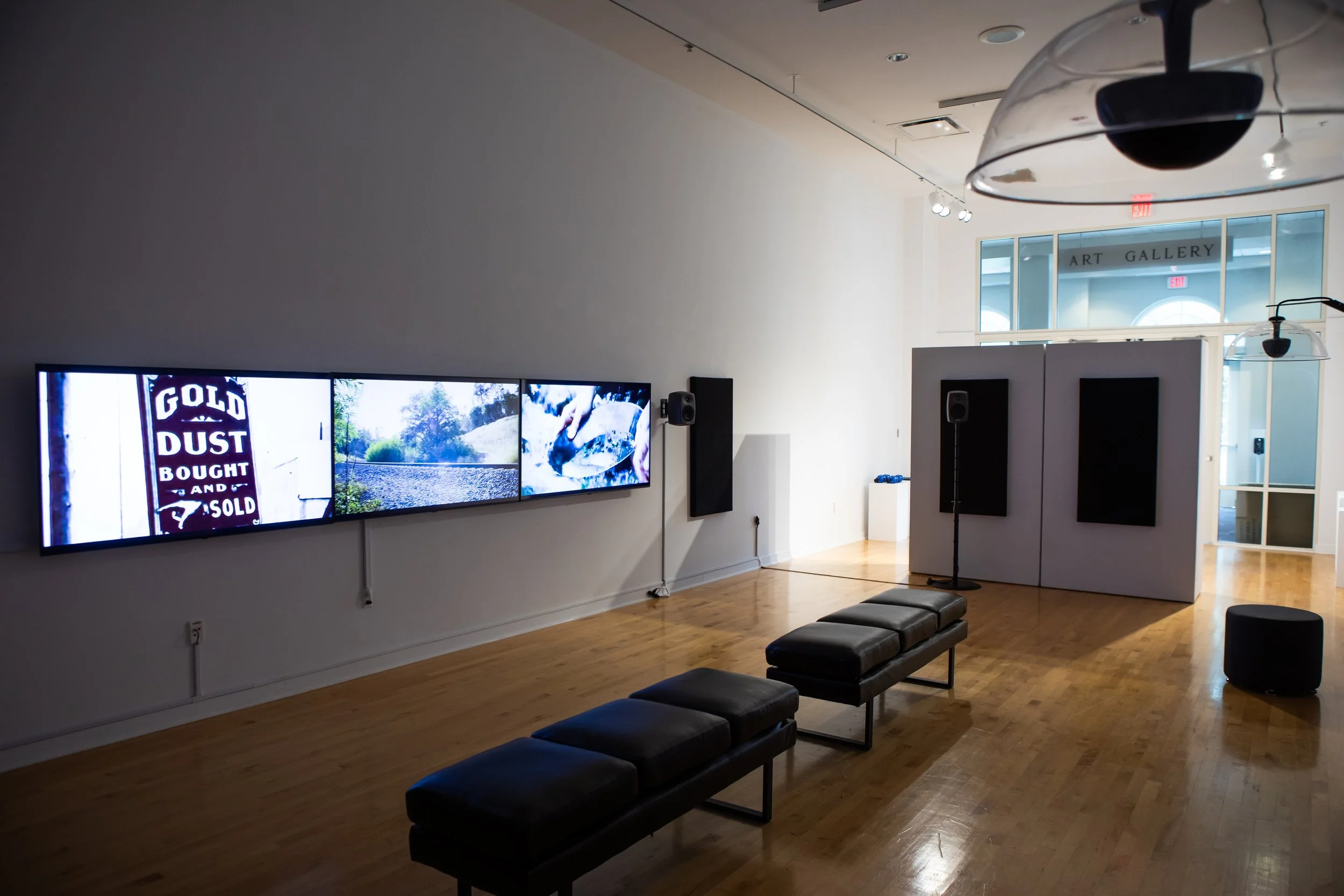


Here There is an immersive multimedia installation that examines early-industrial railroad sites in the United States to trace how colonialism and capitalism have shaped both the physical landscape and the national identity. The project utilizes archival and newly recorded video and sound to place the connections between historical events and contemporary imbalanced power and economic structures in dialogue. It also considers how the technologies of film and locomotion reshaped our relationship to both time and space, compressing distance and expanding us beyond the limits of our embodied sensorial experience of the world.
The post-industrial United States continues to be in a power struggle over how historical narratives are framed and who gets to be remembered. Here There resists dominant narratives and instead of focusing on “manifest destiny” and “great men”, it foregrounds the lived experiences of laborers, Indigenous communities, immigrants, and those whose lives have typically fallen outside the canonical narrative as an act of historical revision. By reframing railroad sites as contested terrains rather than symbols of progress, the project situates memory, power, and erasure as materially embedded in the landscape itself.
The work is a collaboration between composer Caroline Louise Miller, visual artist Stefani Byrd, and world-renowned contemporary music ensemble Alarm Will Sound.
Here There brings together scholarly and lived knowledge through interviews with Dr. Gordon H. Chang, History Professor at Stanford University and author of The Ghosts of Gold Mountain and Dan Stone, retired train conductor of over 30 years from the DeButts Switch Yard in Chattanooga, Tennessee. Stone is also a long-time friend and former colleague of project lead Stefani Byrd’s deceased father, J. Byrd, grounding the work in both scholarly research and personal lineage.
In the first chapter of the trilogy, the camera undertakes a point-of-view passage through the Donner Pass Tunnels in the Sierra Nevada Mountains of Northern California, which were once a critical segment of the Transcontinental Railroad. This site bears the layered markings of three distinct communities across centuries: the Martis people, Chinese railroad laborers, and present-day graffiti writers. Each group has had a distinct relationship to the land and a different reason for mark making. Visual traces from each group map stages of American economic development from Indigenous autonomy prior to capitalism, the rise of monopoly capitalism through industrialization, and the conditions of late capitalism and its ramifications.
This chapter weaves together stereoscopic photography – the virtual reality of its era – alongside contemporary drone footage and satellite imagery. These technologies function as tools of way-finding, allowing a single place to be experienced across time and from multiple vantage points. The work explores both the historical significance of the Donner Pass Tunnels and the ways evolving technologies shape how landscapes are seen, navigated, and understood.


“Too often American history is presented as a celebration of great people, particularly great men, presidents, generals. Working people are often left out of the story and certainly people of color in the past are long overdue their recognition.”
CHAPTER 2: BLOOMER CUT
The second chapter of the trilogy centers on Bloomer Cut, a Transcontinental Railroad site located at the edge of a suburban neighborhood in Auburn, California. When completed in 1864, this location was considered the “Eighth Wonder of the World.” This site is now marked only by a small sign, yet remains an active rail line, one of the few Transcontinental Railroad sites to survive into the present. The sequence is filmed as an embodied phantom passage through the woods to a once-revered feat of human engineering, presented alongside archival film and photographs related to the history of the region. It seamlessly oscillates between past and present to reveal the detrimental impact of Manifest Destiny and settler colonialism on Indigenous communities.
Bloomer Cut is a site shaped by entangled histories of extraction and relocation of resources, lands, and people. Auburn originated as a gold mining camp, which later evolved into a town with the businesses and services necessary to support miners in the region. After gold was extracted from the land, it was weighed and purchased by bankers such as the newly formed Wells Fargo Company, who relocated that wealth to other markets.
At the same time, the decimation of the Indigenous population occurred through diseases such as smallpox and measles, as well as state-sponsored genocide motivated by economic gain. Through legislation such as the Homestead Act, land was taken from Indigenous peoples and redistributed by the federal government to settlers. Many tribes continue to fight in the courts for land and legal recognition, including the Maidu (MY-doo), whose ancestral homelands include what is now known as Placer County.
This chapter explores the forces of American capitalism and their visible impact on a landscape physically altered in service to miners, railroads, and the influx of white settlers. The work adopts a “past-as-present” perspective, examining the outcomes of settler colonialism and industrialization embedded within what appears to be an innocuous suburban neighborhood in Northern California.


DAN STONE
Retired Locomotive Engineer, with over 39 Years of service at the DeButts Yard, Chattanooga, Tennessee
“When you work at the railroad, there’s black and there’s white and there’s gray and gray is the area that they wanted you to work in.”
CHAPTER 3: ROSEVILLE
The third chapter of the triptych centers on the J.R. Davis Yard in Roseville, California, the largest railroad yard in the Western United States. Roseville owes its existence to the railroad, having developed alongside the routes of the Transcontinental Railroad. This chapter foregrounds the experiences of contemporary and historical railroad workers, examining how rail labor has shaped both the city and the nation’s systems of movement, commerce, and supply.
In the 1910s, innovations such as ice-filled railcars operated by the now-defunct Pacific Fruit Express enabled the long-distance shipment of perishable goods from California to the rest of the country. This labor-intensive system relied on workers who maintained and serviced the cars, allowing agricultural wealth to circulate while populations expanded in regions unable to support large-scale food production. Ice cars were later replaced by refrigerated railcars that remain in use today. The film draws from archival photographs and records documenting Pacific Fruit Express workers, including their failed attempt to organize the United Railway Icemen’s Union in the 1930s—a labor movement suppressed under pressure from company management.
The chapter also addresses the physical dangers borne by railroad workers and nearby communities. In 1973, an explosion at the Roseville Yard injured multiple people and damaged surrounding neighborhoods when a railcar carrying ammunition for the Vietnam War detonated. This event resonates with more recent disasters, including the 2023 derailment in East Palestine, Ohio, underscoring the persistent risks of rail labor and the ongoing failures of safety regulation and oversight.
Visually, the chapter combines three perspectives: the point of view of a moving train, a tracking shot filmed from a car alongside the rails, and aerial drone footage of the yard’s vast infrastructure. Footage from the train’s perspective draws from the Thomas Edison film archive in the form of a phantom ride—early pre-narrative films created by mounting a camera to the front of a train. Together, these layered viewpoints trace how labor, technology, and capital have shaped collective relationships to the railroad, and how evolving modes of vision continue to structure our understanding of time, movement, and work.


BUMPER - BENCHING
The term benching emerged among graffiti writers in New York in the 1970s, referring to the practice of gathering at a “bench”—a place to watch and admire graffiti-covered subway cars or freight trains as they pass. This bumper, a brief interlude between films, consists of a single, uninterrupted shot of a moving train and the graffiti that travels across its cars.
For freight graffiti writers, the goal is for a work to circulate across the country and reach a broad audience and visibility becomes reputation. While graffiti remains illegal, many rail yards have arrived at an informal truce with writers. Most have chosen not to remove work—an expensive and labor-intensive process—as long as essential information, such as car numbers, remains legible. An unwritten code governs this coexistence: writers remain out of sight and do not interfere with rail operations, while rail workers, in turn, quietly overlook their presence.


PROJECT CREDITS
ORIGINAL SCORE by Caroline Louise Miller
CINEMATOGRAPHY and EDITING by Stefani Byrd
ORIGINAL SCORE PERFORMED by ALARM WILL SOUND:
ALARM WILL SOUND are
Miles Brown, Michael Clayville, Stefan Freund, Michael Harley, Erin Lesser, Bill Kalinkos, Laura Weiner, Tim Leopold, John Orfe, Christa Robinson, Matt Smallcomb, Elisabeth Stimpert, Courtney Orlando, Alan Pierson, Gavin Chuck, Jason Varvaro, Peter Ferry, Annie Toth, Michael Clayville, Tracey Mendez, Chihiro Shibayama
EXHIBITION TEAM
CATALOG DESIGN by Madison Creech
COPY EDITING by Thomas Mattos
EXHIBITION DESIGN SUPPORT by Keltsey McKoy
SPECIAL THANKS
Roseville Historical Society
Donner Summit Historical Society
Stanford University Library and Special Collections
California State Railroad Museum Library
Dr. Gordon Chang
Dan Stone
CAB Gallery
Keltsey McKoy
Stoveworks
Tom Mattos
Sean McCormick
Michael A. Betts II
SUPPORTED and FUNDED IN PART BY:



The Matt Marks Impact Fund
Sonic Matter OpenLab
Charles L. Cahill Grant
North Carolina Arts Council Artist Support Grant
Filmed in NC Fund, Cucalorus Film Festival
School of Music & Theater, Portland State University
Film Studies Department, University of North Carolina Wilmington
Department of Art & Art History, University of North Carolina Wilmington
CAB Art Gallery, University of North Carolina Wilmington